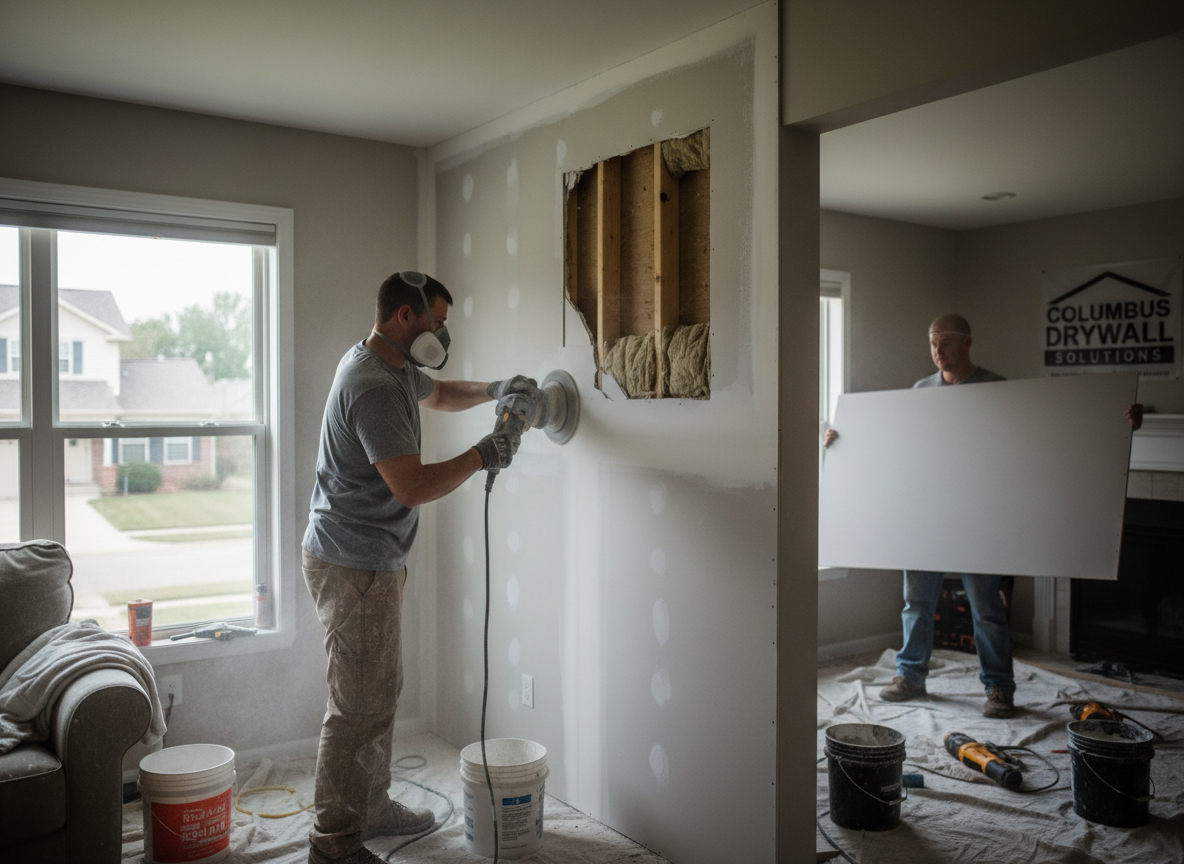
Columbus homes built before 1960 in German Village and Victorian Village often contain plaster over wood lath or early drywall that wicks moisture differently than modern materials. After a pipe burst or roof leak, technicians must remove affected sections at least 12 to 18 inches beyond visible damage to prevent hidden mold growth behind baseboards. Cold winters followed by warm humid summers create repeated condensation cycles inside wall cavities, especially in Clintonville and Grandview Heights bungalows with poor attic ventilation.
When replacing drywall in flood-prone Franklinton or Hilltop properties, crews use moisture meters on both sides of the wall and check subfloor plywood for delamination. Type X or moisture-resistant board is installed where water reached the lower half of the wall, and seams receive fiberglass tape rather than paper to resist future swelling. Old lead-based paint layers common in Bexley and Olde Towne East require careful containment during demolition to avoid dust migration into HVAC systems.
Full ceiling replacements after second-floor leaks demand temporary shoring in Nationwide Arena-adjacent apartments where joist spacing can vary. Texture matching is done with a hand-skip trowel on older homes rather than machine spray to blend with original surfaces. Homeowners in Linden and the Hilltop frequently discover that insurance adjusters require photographic documentation of the moisture gradient before approving replacement beyond the obvious water line.
Technician insight
In Columbus, the thing that catches most people out with Drywall Replacement & Repair is water that has wicked upward into plaster keys behind the drywall in pre-war homes in German Village and Olde Towne East. Winters here drive repeated freeze-thaw cycles that push moisture higher than the obvious water line, so cutting only to the visible stain almost always leaves saturated material that later grows mold.
Clintonville Pipe Burst
A kitchen supply line froze and burst during a January cold snap, saturating the wall behind the sink in a 1920s Clintonville bungalow. The crew found moisture had traveled up into the plaster keys and across to the adjacent pantry wall. They removed two full sheets, dried the cavity for four days, and replaced the drywall with moisture-resistant board before texturing to match the original. The homeowner was able to repaint within a week without visible repair lines.
Drywall Replacement & Repair Services We Offer
✓Water Damage Drywall Assessment
Room-by-room moisture mapping with infrared imaging to locate hidden saturation in walls and ceilings of Columbus homes.
✓Drywall Removal and Disposal
Safe cutting and removal of saturated drywall sections while protecting flooring and containing dust in older Franklin County properties.
✓Moisture Extraction and Structural Drying
Placement of air movers and dehumidifiers sized for the square footage and humidity levels typical after Ohio winter pipe bursts.
✓Drywall Patching and Texturing
Seamless patches that match existing textures in neighborhoods such as Short North and German Village without visible seams.
✓Full Wall and Ceiling Replacement
Complete replacement of water-damaged drywall including insulation replacement where freeze-thaw cycles have occurred.
✓Basement Drywall Restoration
Replacement of lower wall sections in finished basements common in Bexley and Clintonville after sump pump or sewer backup events.
Drywall Replacement & Repair Cost in Columbus, OH
| Service | Typical Range | What Affects It |
|---|---|---|
| Small wall patch under 4 sq ft | $250–$450 | Price rises if multiple layers of old plaster must be removed first. |
| Standard wall section 4–12 sq ft | $450–$850 | Includes drying time and texture match in pre-1960 homes. |
| Full wall replacement per linear foot | $90–$160 | Higher in basements where mold-resistant board is required. |
| Ceiling panel replacement | $600–$1,200 | Depends on access and whether joists need checking for rot. |
Ranges are typical for Columbus, OH and confirmed with an exact written quote before any work starts.
How it works
- 1
On-Site Moisture Survey
Technician maps all affected drywall using meters and thermal imaging while documenting conditions in the specific Columbus neighborhood.
- 2
Controlled Demolition
Remove saturated material to sound substrate, bagging debris to limit spread of any existing mold spores.
- 3
Drying and Verification
Apply drying equipment and recheck moisture levels daily until readings match unaffected areas of the home.
- 4
New Drywall Installation
Hang, tape, and finish replacement boards using materials suited to the home's age and location within Franklin County.
- 5
Final Texture and Paint Prep
Match original texture and prime surfaces so the homeowner can repaint without visible repair lines.
Pricing
Most drywall repair jobs after water damage fall into a mid-range price band that scales with square footage and whether insulation must be replaced.