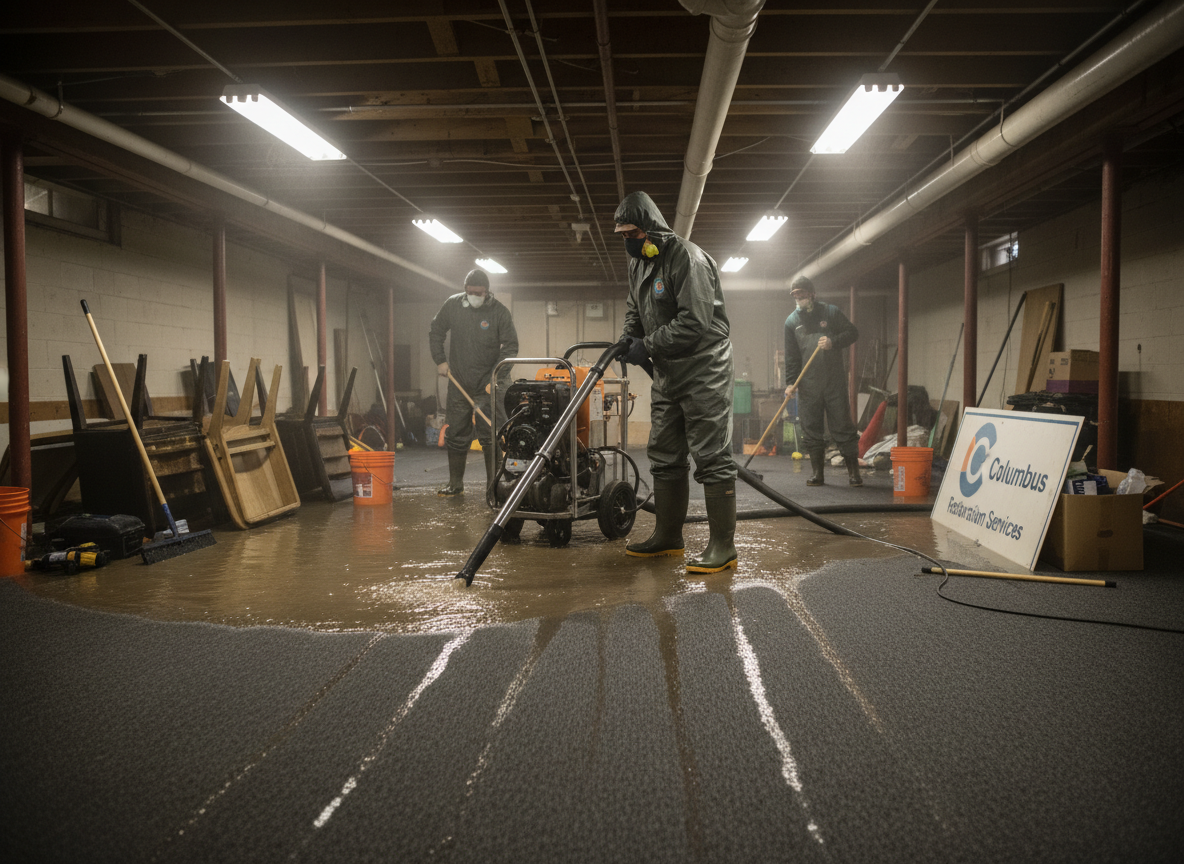
Columbus housing stock built before 1950 in neighborhoods like German Village and Victorian Village often features plaster over lath walls and crawl spaces that trap water against joists. During humid continental winters, frozen supply lines in unheated basements of these homes release large volumes once temperatures rise, saturating subfloors before homeowners notice. Extraction crews must pull carpet pads and baseboards immediately to prevent wicking into adjacent rooms, especially where brick foundations meet clay-heavy soil that slows natural drainage.
Summer thunderstorms can overwhelm downspouts on older Franklinton and Hilltop properties, sending water through window wells into finished lower levels. Technicians use truck-mounted pumps rated for 200-plus gallons per minute followed by portable extractors on hardwood to avoid cupping. In these cases, drywall sections along exterior walls frequently require removal up to the moisture line, which can sit higher than visible staining because capillary action travels through gypsum.
Franklin County terrain near the Scioto River corridor creates pockets of poor drainage around Olde Towne East and Linden, where slab-on-grade homes sit close to grade. Emergency extraction here includes checking for hidden water under vinyl plank or laminate that has floated and reseated, trapping moisture against the concrete. Crews document every affected square foot before leaving to guide later drywall repair and reduce the chance of hidden mold growth behind cabinets or in HVAC returns.
Technician insight
In Columbus, the thing that catches most people out with Emergency Water Extraction is how quickly water travels behind plaster in German Village and Victorian Village homes after a winter pipe burst; if you stop at the visible puddle you will still have wet lath six inches up the wall that later needs drywall repair.
Frozen Pipe in Bexley
A cold snap caused a supply line to burst in a 1920s Bexley home. Water traveled under the dining room floor and wicked into plaster walls. Extraction removed bulk water, opened baseboards, and set drying equipment. Moisture mapping confirmed the drywall sections that later required repair, preventing mold behind the cabinets.
Emergency Water Extraction Services We Offer
✓Burst Pipe Water Extraction
Immediate removal of water from supply or drain line failures common in pre-war Columbus homes, followed by targeted drying of joists and subfloors.
✓Flooded Basement Pumping
High-volume pumping and extraction for rainwater or appliance overflow in lower levels of German Village and Bexley properties.
✓Sewage Backup Cleanup
Extraction and containment of contaminated water from main line backups that affect older clay sewer laterals in Short North and Clintonville.
✓Appliance Leak Extraction
Rapid water removal from water heater or washing machine failures, protecting adjacent drywall and flooring in Grandview Heights homes.
✓Roof Leak Water Extraction
Ceiling and attic water removal after storm damage, with moisture mapping to locate migration paths in Victorian Village plaster ceilings.
✓Crawl Space Water Removal
Extraction from under-home spaces where poor grading around Hilltop and Linden foundations allows water to pool against sill plates.
Emergency Water Extraction Cost in Columbus, OH
| Service | Typical Range | What Affects It |
|---|---|---|
| Single-room extraction | $250–$650 | Higher when plaster walls in German Village homes require opening. |
| Basement level pumping | $400–$950 | Increases with sewage contamination or multiple inches of water. |
| Crawl space extraction | $300–$700 | Varies by access difficulty and amount of standing water. |
| Appliance or fixture leak | $200–$500 | Lower when limited to hard surfaces and caught early. |
Ranges are typical for Columbus, OH and confirmed with an exact written quote before any work starts.
How it works
- 1
Safety And Access
Shut off power and water sources, then establish safe entry paths before equipment enters the structure.
- 2
Standing Water Removal
Deploy truck-mounted and portable extractors to pull bulk water from floors, carpets, and low areas.
- 3
Moisture Mapping
Use meters and infrared cameras to locate hidden water in walls, under flooring, and in cavities typical of older Columbus construction.
- 4
Initial Containment And Drying Setup
Place air movers and dehumidifiers, remove saturated baseboards, and document conditions for later drywall repair.
Pricing
Cost depends on water volume, number of affected rooms, and whether hidden moisture requires drywall opening in older homes.