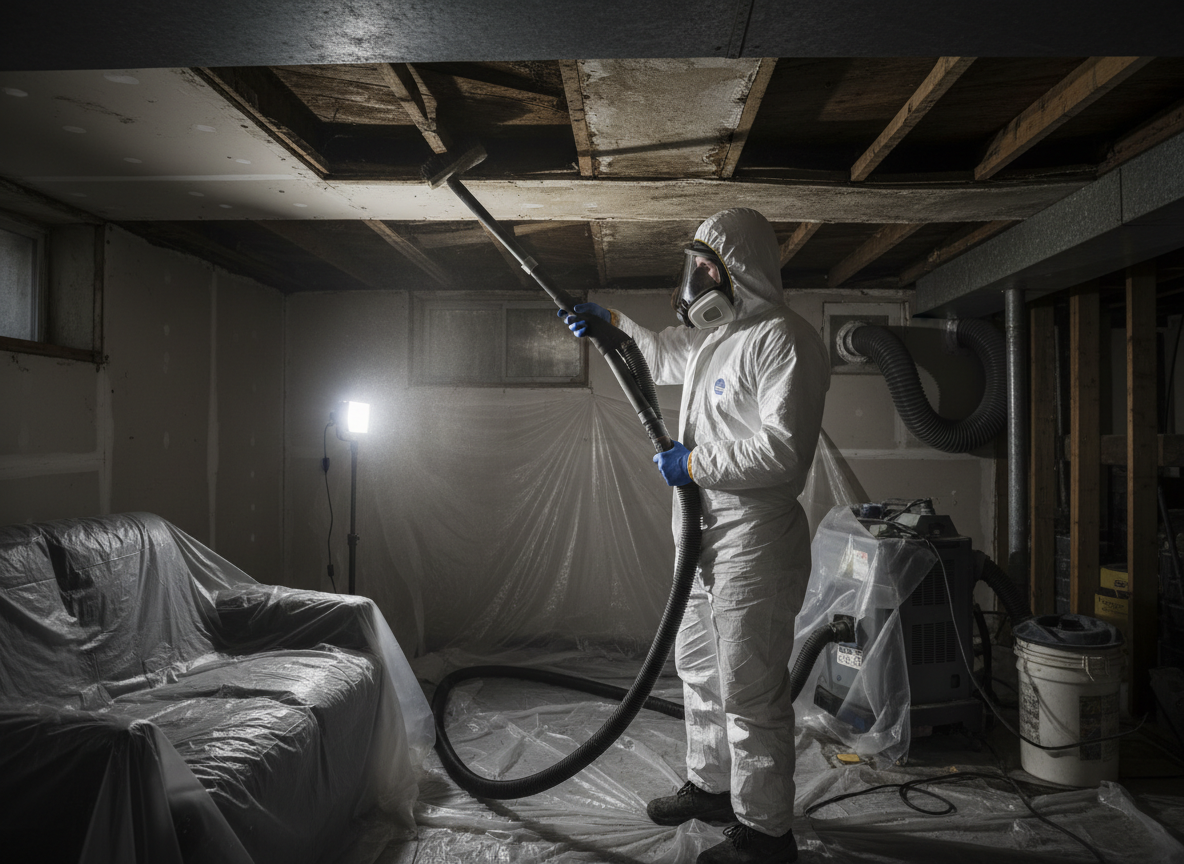
Columbus homes built before 1960 in Victorian Village, German Village and Olde Towne East often have plaster over lath that hides moisture after roof leaks or pipe bursts. Warm humid summers allow spores to colonize quickly once water enters wall cavities, while winter freeze-thaw cycles in Franklin County push water through foundation cracks in Hilltop and Linden bungalows. Remediation requires removing affected drywall or plaster sections rather than surface cleaning alone, followed by negative-air containment to keep spores out of living spaces.
Post-flood work in Franklinton and Grandview Heights frequently involves Category 3 water that saturates subfloors and baseboards. Without rapid extraction and dehumidification to below 50 percent relative humidity, mold returns within days once temperatures rise. Technicians must cut back drywall at least 18 inches past visible growth and treat joists with EPA-registered antimicrobials before new material is installed.
HVAC systems in Bexley and Clintonville split-levels can spread spores through the entire house when coils stay damp. Remediation includes coil cleaning, duct inspection and sometimes full trunk-line removal when insulation inside the ducts is contaminated. Homeowners in these neighborhoods commonly mistake musty odors for normal basement smells until air sampling confirms elevated spore counts.
Drywall repair after mold removal must match the original wall thickness and texture found in 1920s–1950s stock common across Short North and Nationwide Arena-adjacent streets. Skipping vapor barriers or using non-mold-resistant board in high-moisture zones like bathrooms leads to repeat growth within one heating season.
Technician insight
In Columbus the thing that catches most people out with Mold Remediation is 1920s–1940s plaster homes in German Village and Victorian Village where winter freeze-thaw pushes water behind baseboards and homeowners keep painting over the stain instead of opening the wall.
Hidden Growth Behind Drywall in Clintonville
A burst pipe in a 1938 Clintonville bungalow soaked the kitchen wall. Inspection found mold extending two feet past the visible water line inside the plaster. Crews removed the affected section, treated the studs, and dried the cavity to 45 percent RH before new drywall was installed.
Mold Remediation Services We Offer
✓Black Mold Removal
Removal of Stachybotrys and other toxigenic molds from water-damaged walls and ceilings in Columbus homes, followed by source correction and clearance testing.
✓Basement Mold Remediation
Treatment of mold on concrete, framing and drywall in below-grade spaces common in Hilltop and Linden, including vapor barrier installation to reduce future humidity.
✓Attic Mold Remediation
Cleaning and treatment of mold growth on roof sheathing and rafters caused by ice dam leaks or poor ventilation in Victorian Village and Bexley homes.
✓Drywall Mold Remediation
Cut-out and replacement of mold-affected drywall with moisture-resistant board, tied directly to the water source repair in Franklin County properties.
✓Post-Flood Mold Cleanup
Full remediation after Category 3 water events in Franklinton and Grandview Heights, including antimicrobial application and structural drying before reconstruction.
✓HVAC Mold Cleaning
Coil and duct cleaning to stop spore circulation through forced-air systems in split-level homes throughout Clintonville and Short North.
Mold Remediation Cost in Columbus, OH
| Service | Typical Range | What Affects It |
|---|---|---|
| Small bathroom or closet remediation | $800–$1,600 | Increases with plaster walls or hidden growth behind tile |
| Basement wall and floor treatment | $1,800–$3,500 | Higher when subfloor or joists require removal |
| Attic mold remediation | $1,200–$2,800 | Varies with roof access and insulation type |
| HVAC coil and duct cleaning | $600–$1,400 | Full trunk replacement adds to cost |
Ranges are typical for Columbus, OH and confirmed with an exact written quote before any work starts.
How it works
- 1
Inspection And Moisture Mapping
Technicians use moisture meters and thermal imaging to locate hidden water in walls and floors of the affected Columbus property.
- 2
Containment Setup
Plastic barriers and negative air machines isolate the work area to prevent spore migration into unaffected rooms.
- 3
Removal And Cleaning
Contaminated materials are removed, surfaces are HEPA-vacuumed and treated with EPA-registered antimicrobials.
- 4
Drying And Clearance
Dehumidifiers and air movers reduce moisture to safe levels, followed by independent air sampling before drywall repair begins.
Pricing
Project pricing depends on square footage, material type and whether HVAC or structural cavities are involved; written quotes follow inspection.